
First, get out of the traffic flow if you can
A sudden loss of power on I-8 can turn a familiar East County drive into a stressful decision. Your first job is not diagnosing the car. It is finding the safest available place to stop without making abrupt movements. Keep control of the steering, signal if possible and move away from flowing traffic when the vehicle can still move. Do not force a failing vehicle across lanes or reverse along the freeway to reach an exit.
If the vehicle stops in a travel lane, there is an injury, smoke, fire or another immediate danger, call 911 and follow the dispatcher’s instructions. A routine tow request is not a replacement for emergency help. Switch on the hazard lights once stopped. Note whether you are eastbound or westbound: the same nearby landmark can mean a very different approach for a tow truck depending on your direction.
Decide where to wait based on the actual scene
There is no single waiting position that is safe in every freeway breakdown. A wide shoulder, a narrow bridge, a guardrail and a vehicle partly in traffic present different risks. Stay buckled or get behind the guardrail if it is safe. Do not step into a traffic lane, stand between the car and passing vehicles, or cross the freeway. If you are unsure, ask emergency services for guidance specific to your position.
Before opening a door, look at which side is nearest traffic and whether there is somewhere genuinely protected to go. Keep children and passengers together and away from moving vehicles. Avoid standing directly in front of or behind your stopped car. At night, do not assume approaching drivers can see you simply because you have hazard lights on. Your visibility and escape space matter more than getting a closer look at the problem.
For help with this situation, explore our light-duty towing service or towing in El Cajon.
Make a location note before your battery runs down
A useful pickup location includes the freeway number, direction and nearest exit or mile marker. In East County, “I’m near El Cajon” is a starting point, not a complete location. Look for an exit sign or the last exit you passed without walking toward traffic. If you can safely use your phone, open its map and note the coordinates or location pin. Keep the map available so you can repeat the information clearly.
Describe your side of the road and anything that affects access: a narrow shoulder, a curve, a barrier, a slope or a car that cannot roll. If you are on an on-ramp, off-ramp or surface street rather than the main freeway, say that explicitly. Phone location can be approximate, so combine it with visible road details. Do not wander looking for a sign if that would take you out of a protected waiting place.
Have four things ready when you call
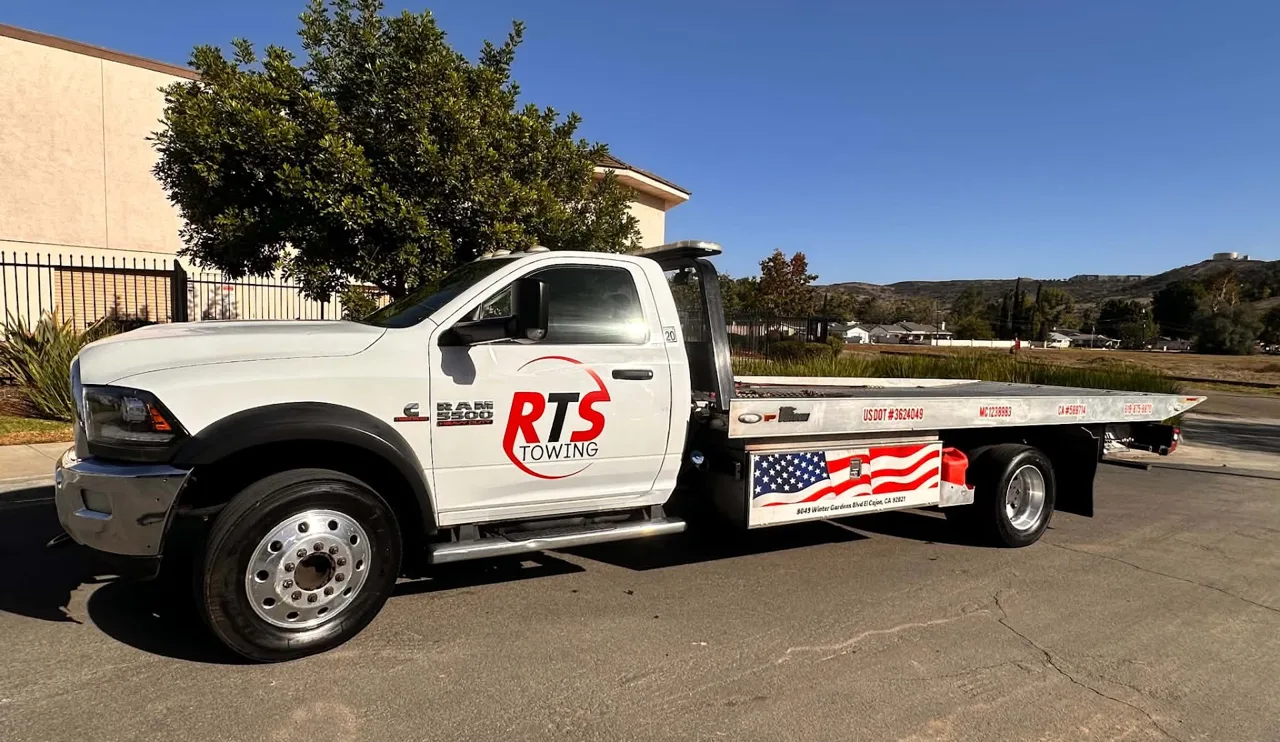
RTS Towing needs your exact location, the vehicle’s year, make and model, what happened and where you want it taken. The vehicle details help plan a light-duty flatbed pickup. Say whether it is an EV, AWD, lowered or modified, and whether steering or wheels are locked. Describe symptoms plainly: the engine stopped, a tire blew, smoke appeared, or the dashboard showed a warning. You do not need to guess a mechanical diagnosis.
Pick a destination you can actually use, such as a mechanic, dealer, body shop or home. If a shop is closed, check its after-hours arrangements rather than assuming the vehicle can be left there. We discuss price and an arrival estimate before we roll. There is no membership requirement, and our base is El Cajon with service throughout San Diego County. Ask anything that would affect your decision before agreeing to the pickup.
Avoid turning a breakdown into a roadside repair project
A usable spare or a loose battery connection may look like a quick fix, but the traffic environment decides whether any work is sensible. Do not crawl under a vehicle, jack it up beside passing traffic or open the hood if smoke or heat makes it unsafe. A tire change can wait until there is a safe place to work. If the shoulder cannot support safe roadside service, discuss transport rather than trying to complete a repair there.
Stay available for the call or text that confirms pickup details, but preserve phone charge. Send one clear description rather than repeatedly walking around the vehicle for more photos. If police or CHP are managing the scene, follow their instructions. CHP-assigned rotation tows follow CHP’s own process; calling a preferred provider does not override the officer’s directions. Tell us about any instructions you have already received so arrangements do not conflict.
Use the waiting time to organize the next step
When it is safe, keep your keys, phone and identification accessible. Tell the driver about passengers, pets or anything special that affects loading. Riding along depends on space in the truck, so ask before assuming everyone can travel with the vehicle. Make separate arrangements if necessary. Leave belongings alone if collecting them would require stepping into danger. Safety takes priority over making the vehicle perfectly ready for transport.
After the tow, keep the itemized receipt for your records and any insurance reimbursement request. Coverage depends on your policy, not on having called a towing company. RTS Towing accepts cash, major credit and debit cards, Apple Pay, Zelle and Venmo. If you are still on I-8, focus first on your waiting position and exact location. Call or text us when you are safely able, and we will discuss a plan for your vehicle.